
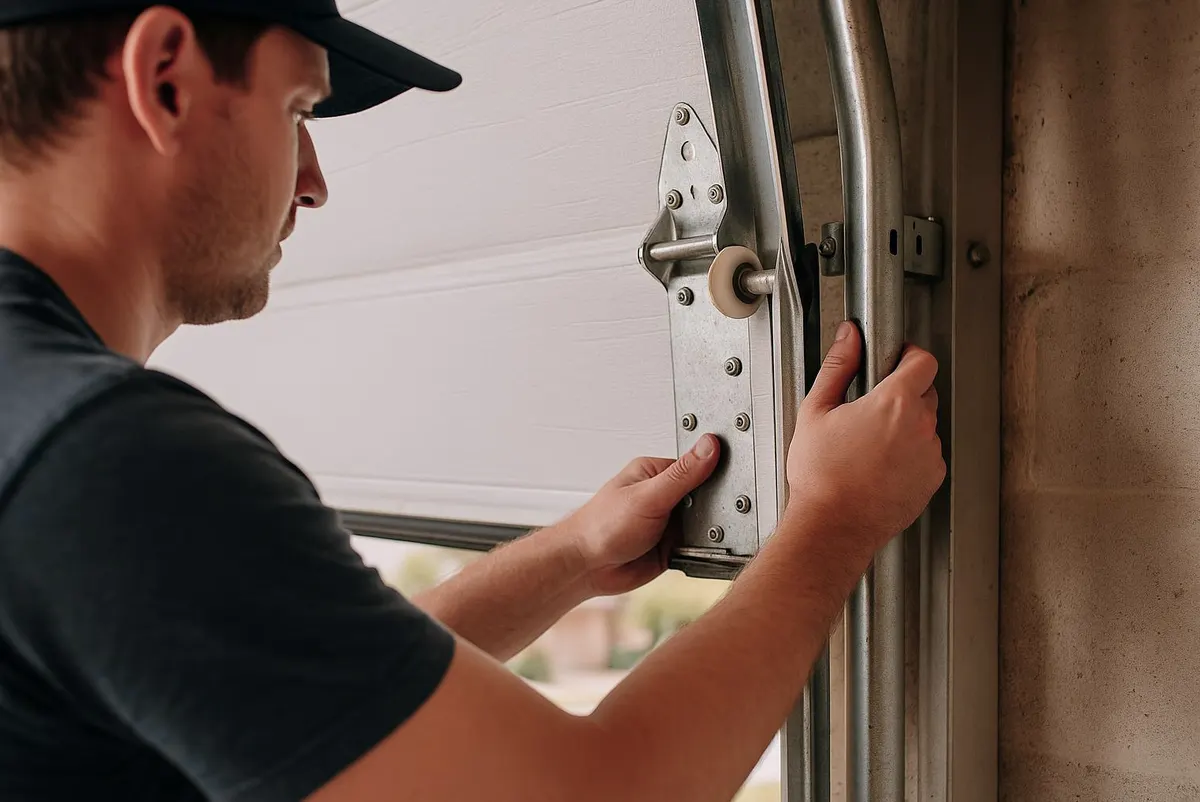
What a Technician Sees After a Bad Blow
The call usually comes in the day after a storm: a door that's bowed outward in the middle like a soda can that's been stepped on, rollers popped clean out of the track, or a panel that's caved in because something — wind pressure, debris, both — pushed harder than the door was built to handle. Sometimes the door is still technically closed, but the track is bent two inches out of true and the opener is straining against it. Occasionally it's worse: the door blew in entirely, and now there's water and wind damage inside the garage itself. Almost every one of these calls traces back to the same root cause — the garage door gave way before anything else on the house did.
Why the Garage Door Is the Weakest Wall in the House
A garage door is the largest moving opening in most homes, and it's held in place by rollers, tracks, and springs rather than the kind of rigid framing that holds a wall together. When wind hits the front of a house, it creates positive pressure pushing in and negative pressure (suction) trying to pull surfaces out. Most walls, windows, and the roof are built to resist that. A standard, older garage door often isn't — especially if it's a lightweight panel door without internal bracing.
Once a garage door fails, wind rushes into the garage and pressurizes the whole house from the inside. That's when roofs start to lift and walls start to separate. This is why wind-load-rated garage doors and reinforcement aren't just a nice-to-have in South Florida — building codes in hurricane-prone areas specifically target garage doors because engineers know they're the first thing to go.
Humidity and Salt Air Make It Worse Year-Round
Even outside of an actual storm, the climate here works against a garage door every day. Humidity swells wood-composite panels and door jambs, which throws off the door's fit in the track and makes it bind or stick. Salt air drifting in from the coast accelerates rust on springs, hinges, rollers, and tracks faster than it would further inland. A door that's already a little rusty or slightly misaligned is far more likely to fail catastrophically under storm-force wind than one that's been properly maintained.
Pre-Storm-Season Checklist for Garage Doors
With active weather still very much in play this time of year, this is the right window to get ahead of it rather than scramble the night before a system is tracking toward Florida.
- Check the panels for flex. Push gently on the middle of each panel. Noticeable give or visible bowing means the door isn't rigid enough to resist wind load as-is.
- Inspect tracks and rollers. Look for rust, bent sections, or rollers that are cracked or worn flat on one side. A track that's slightly out of alignment now can fail completely under pressure.
- Test the auto-reverse safety feature. Place a block of wood in the door's path and close it. It should reverse on contact. This matters for everyday safety, but a malfunctioning sensor also often points to a door that's out of alignment generally.
- Look at the weatherstripping. Cracked or missing seals around the bottom and sides let wind-driven rain in during the afternoon downpours common here, and let humid air swell the door panels faster.
- Lubricate hinges, rollers, and springs. A silicone-based lubricant (not WD-40, which attracts grit) helps slow salt-air corrosion between inspections.
- Consider horizontal bracing or a retrofit wind-load kit. These kits add steel struts across the back of an existing door to stiffen it against wind pressure, and they're a lower-cost option than full replacement — generally in the low hundreds of dollars installed, compared to a full door replacement.
Retrofit Bracing vs. Full Replacement
If the door itself is structurally sound — no rot, no major rust, panels still rigid — a bracing kit paired with reinforced rollers and track hardware can bring an older door much closer to current wind-resistance standards without the cost of replacement. But if the door is already flexing, the panels are aging out, or it's been through a few storms and shows cumulative stress (hairline cracks, warped sections, a track that's been re-bent more than once), bracing is putting a patch on a door that's going to fail anyway. At that point a wind-rated replacement door is the more honest fix, even though it costs more upfront — generally a few hundred to a couple thousand dollars more than a standard door, depending on size and material.
When to Call Wilton Manors Garage Door Pro
If your door is sagging in the middle, the track is visibly bent, or it's been limping along since the last storm season, don't wait for the next system to find out it won't hold. We handle Off Track Door Repair for doors that have already shifted out of alignment, and we do full Garage Door Replacement with wind-rated doors built for exactly the conditions Wilton Manors sees every hurricane season. We'll also walk the whole system — springs, cables, rollers, opener — and tell you straight whether a tune-up and reinforcement will get you through the season or whether it's time to replace.
If you're in Wilton Manors, Oakland Park, Fort Lauderdale, or anywhere nearby and want your garage door storm-ready before the next system develops, call Wilton Manors Garage Door Pro today and get it checked out now, not after the warning's already up.